
Safety first: Meeting evolving fire safety demands in commercial buildings.
Non-combustible fire-resistant insulation requirements are undergoing a rapid transformation in response to tightening regulations and rising performance expectations. Today’s commercial buildings must deliver energy efficiency, occupant comfort, and robust fire protection. Achieving this balance requires materials that are non-combustible, thermally efficient, acoustically effective, compatible with modern design aesthetics and can be used as part of a passive fire protection system design so they perform in the event of a fire.
So, what’s evolving in insulation performance for fire safety, and how are designers, engineers, and manufacturers responding to meet these emerging requirements?
Understanding insulation performance in fire safety
There are two key provisions often discussed in relation to insulation and fire safety: 1) reaction to fire and 2) fire resistance.
It’s important to understand the difference between these two metrics when specifying products for fire safety applications.
Reaction to fire evaluates how a material contributes to fire development and spread. A product's reaction to fire performance is critical in the early stages of a fire.
Fire resistance measures the ability of a complete system to resist fire penetration and maintain performance over a defined period. In the fire compartmentation strategy of a building, the fire resistance of the systems used is an essential part of the design criteria.
For some applications, building regulations restrict the use of combustible materials or specify the minimum reaction to fire rating for products.
In the UK and Europe, insulation products are tested and classified under the European Reaction to Fire classification of construction products and building elements – Part 1: Classification using data from reaction to fire tests (EN 13501-1:2018 ). This is a standardised test method to assess how construction products behave when exposed to fire. Construction products will be classified dependent on their performance:
- A1 to E with additional classifications for products rated A2 - D,
- Smoke production (s1-s3) with s3 being the worst
- Any character changes such as droplets (d0 - d2, with d2 being the worst).
Euroclass A1 materials do not contribute to fire spread, while A2-s1, d0 materials offer no significant contribution.
Fire resistance testing evaluates the performance of a complete construction or assembly to maintain its structural integrity/load bearing capacity (R), prevent fire penetration/integrity (E) and limit heat transfer/insulation (I). For example, a classification of 60 minutes fire resistance would be written as REI 6 0 when tested to BS EN 1365-1.
Taking a whole-system approach
Modern fire safety design has shifted from isolated product selection to system-level integration, testing the full solution in conjunction with each other. Achieving reliable fire performance means considering how all building elements interface interact - such as floor-to-wall, roof-to-wall, and façade-to-structure connections - and how services like pipes, ducts, and cables penetrate these junctions.
However, even the most robust design can be compromised by poor installation. Issues such as gaps between slabs, missing seals, or incorrectly applied firestopping can significantly weaken fire containment strategies. This underscores the importance of precision on-site: accurate detailing and execution during construction are just as critical as having well-specified systems on paper.
Why insulation material choice matters
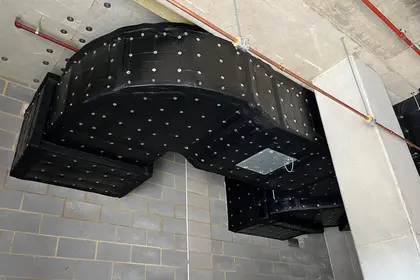
Specifying suitable insulation materials is a critical, and often complex, aspect of designing for fire safety. The challenge lies not only in ensuring that materials meet fire performance requirements, but also in aligning with broader building objectives such as thermal efficiency, durability, sustainability, and acoustic control.
On-going fire safety: beyond handover
Fire protection doesn’t end at practical completion. Building modifications - such as service additions or layout changes - can compromise firestopping. Regular inspection and maintenance of fire doors, seals, and penetrations are essential to preserve compartmentation and compliance.
Facilities teams should implement structured inspection routines and ensure any changes trigger a fire strategy review. Documentation, proactive repairs, and adherence to the Building Safety Act and Golden Thread are key to long-term safety.
Final thoughts
As buildings become more complex and performance expectations rise, fire protection has to keep pace. Meeting the changing demands of fire protection means thinking holistically - combining high-performance materials with good design, quality installation, and long-term maintenance.
Design your fire-safety insulation approach with Isover
Whether you're specifying for a new build or upgrading an existing building, Isover offers comprehensive support and high-performance for your project. Want to know more or need support on your next project? Get in touch