
Thermal vision: Insulation and fabric-first thinking for the future of the UK’s homes
As the UK pushes forward with net-zero targets, there’s growing recognition that the best way to reduce energy use in buildings isn’t just by installing the latest low-carbon tech - it’s by starting with the basics. That’s the idea behind the fabric-first approach, focusing on insulation, airtightness and thermal continuity right from the beginning to help minimise heat loss and make any heating system (whether traditional or cutting-edge) work more efficiently.
At the heart of this approach is the building envelope. A well-insulated structure can reduce the energy needed to keep it warm in winter and cool in summer. And when it comes to insulation, mineral wool continues to offer thermal insulation and acoustic performance in one package (product dependent on project requirements). Let’s take a closer look at insulation, and what makes mineral wool so effective.
The principles of good thermal insulation
Any building with an internal temperature higher than the external temperature will lose heat. So, let’s start with the core principles of good insulation:
Thermal insulation
Thermal insulation reduces heat loss and helps to conserve energy and reduce heating costs. To comply with Building Regulations, levels of thermal performance are required for the external walls, roof and floors of almost all building types. Adequate insulation must also be provided for hot water heating services, pipes, warm air ducts and hot water storage vessels.
Airtightness
Airtightness describes the air leakage characteristics of a building. This determines the uncontrolled background ventilation or leakage rate of a building.
Overheating
With rising temperatures and more frequent heatwaves, overheating in homes poses serious risks to health and comfort – especially for vulnerable occupants. Effective design and ventilation are essential to prevent indoor temperatures from reaching unsafe levels.
Now, what is mineral wool and why is it used in a fabric-first approach?
Mineral wool is an insulation material used in all types of buildings and structures – from homes, offices and schools to hospitals and industrial buildings. Thanks to its specific characteristics, mineral wool can be used for enhancing the thermal performance of a building, as well as for acoustic management – perfect for a fabric-first approach.
Why? Because, in fabric-first projects, the goal is to create a building that’s thermally efficient from the ground up – reducing reliance on mechanical heating and cooling, and improving comfort and efficiency for years to come. Mineral wool can offer advantages such as:
- Thermal performance
- Acoustic performance
- Reaction to fire rating of A1 or A2
- A wide range of formats and sizes
Common uses of mineral wool include insulating walls, roofs, ceilings, floors, ductwork and pipe insulation. So, whether you’re designing a new building or engaged in a retrofit or refurb project, mineral wool can help you meet thermal performance standards.
How is mineral wool made?
There are two types of mineral wool: glass wool and stone wool. Both are made from natural and recycled materials, but with different starting points. For example:
- Our Isover glass wool products manufactured in the UK contain recycled glass. This is a combination of 52% externally sourced recycled glass and 30% internally sourced glass cullet.
- Isover stone wool is produced using volcanic rock, like basalt or dolomite. Please check individual products’ EPDs for specific levels of recycled content in stone wool products imported into the UK.
The process for making both are broadly the same:
- Raw materials are melted at high temperatures (up to 1,400°C for glass wool, 1,600°C for stone wool) in a furnace
- The molten material flows into a spinner, which turns it into fine fibres using centrifugal force
- A binder is sprayed onto the fibres, helping them stick together and form a mat, which is then cured in an oven, giving it rigidity and shape
- It’s then cut to size, faced (if required), and packaged as rolls, slabs or batts – ready for delivery and installation
Why is mineral wool so effective?
Thermal performance
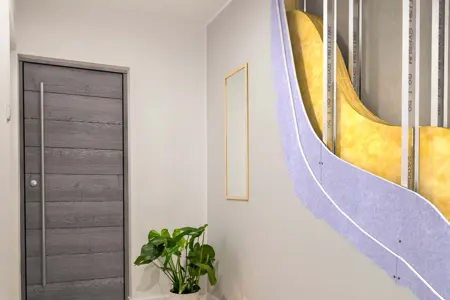
The small pockets within the mineral wool structure trap air, which is a poor conductor of heat. Used as part a system to provide thermal insulation, mineral wool can help to improve thermal efficiency and reduce overall energy costs.
Reaction to fire
Mineral wool products, including glass and stone wool, are non-combustible, achieving Euroclass A1 or A2-s1, d0 ratings depending on the product using the BS EN 13501-1 fire classification system. Euroclass A1 means a material is non-combustible, while A2-s1, d0 refers to limited combustibility with minimal smoke production, and no flaming droplets or particles.
Acoustic performance
The non-continuous structure of the fibres that make up mineral wool impede the passage of sound. This can be used in systems to reduce airborne sound performance between rooms and floors when installed in accordance with the manufacturer’s system installation guidance.
Finally, some common terminology around thermal solutions
Understanding the terminology around thermal performance helps you comply with Building Regulations and meet customer expectations.
Thermal
‘Thermal’ refers to anything related to heat or temperature changes in building design.
Thermal conductivity (l)
The measure of a material’s ability to transmit heat.
Thermal transmittance (U-value)
A property of the whole wall or roof build-up, including air spaces, and a measure of its ability to transmit heat under steady state conditions.
Thermal resistance (R)
The measure of the resistance to the passage of heat offered by the thickness of a material.
Thermal bridging
A thermal bridge in a residential house refers to a specific area within the building envelope where heat can easily escape due to a material with higher thermal conductivity interrupting the insulation layer.
Isover mineral wool products for fabric-first projects
At Isover, we offer a wide range of mineral wool insulation products – from rolls and batts to slabs and pipe insulation. Whether you're aiming for thermal performance, acoustic comfort or fire resistance performance, or most likely all three, there’s a solution in our range that can help you deliver energy-efficient buildings that feel great to live and work in.